

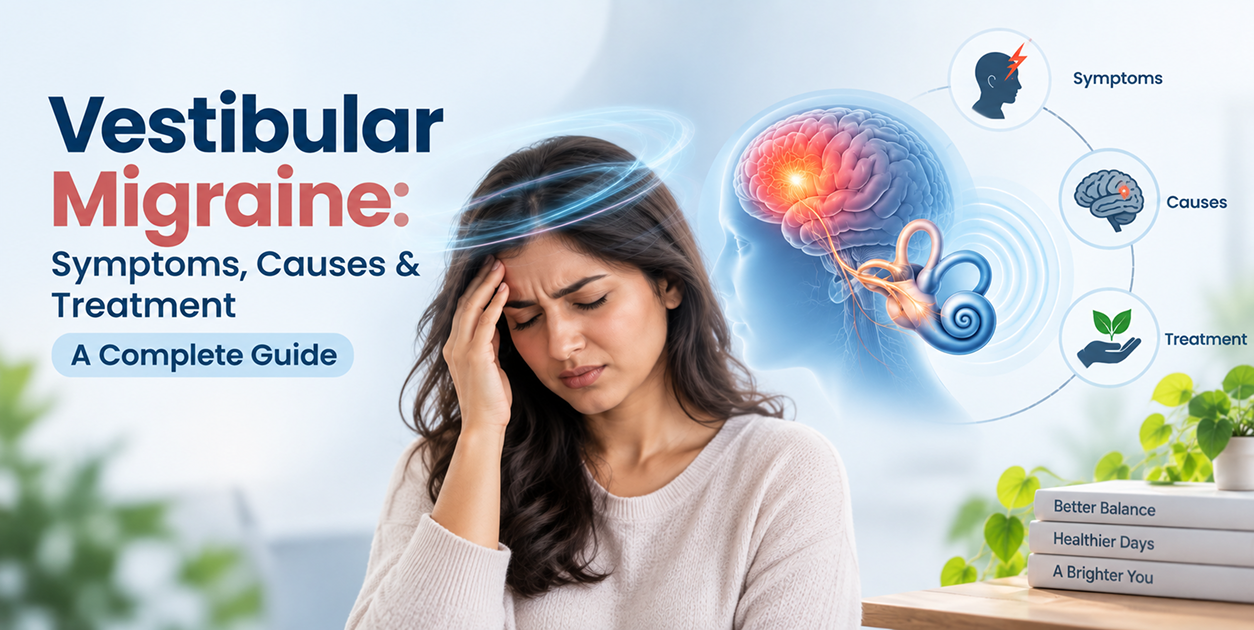
What Is Vestibular Migraine?
What Is Vestibular Migraine?
Vestibular migraine is a neurological condition that affects the vestibular system — the part of the inner ear and brain responsible for balance, coordination, and spatial orientation — causing recurring episodes of dizziness or vertigo connected to migraine.
Unlike a typical migraine, head pain isn’t required for a diagnosis. Some people experience mild pain, others none at all, and some experience pain separately from the dizziness episodes. This is one of the main reasons vestibular migraine is frequently misdiagnosed as an inner-ear disorder or anxiety-related dizziness. Research places it as the second most common cause of episodic vertigo after benign paroxysmal positional vertigo, with a lifetime prevalence of roughly 3.2% in the general population. Episodes can last minutes, hours, or in some cases a few days, with most people feeling entirely normal between episodes — which is part of why the condition is easy to dismiss until it starts disrupting daily life.
Key takeaways
- Vestibular migraine causes dizziness, vertigo, or balance problems linked to migraine often without a headache
- It's the second most common cause of episodic vertigo, affecting roughly 3.2% of people over their lifetime
- Episodes can last minutes to a few days, with normal functioning in between
- There's no single diagnostic test diagnosis relies on symptom history and ruling out other causes
- Common triggers include stress, hormonal shifts, poor sleep, and dietary factors
- Homeopathic treatment targets the underlying trigger pattern rather than individual episodes
- Persistent, worsening, or hearing-related dizziness warrants a proper clinical evaluation
Symptoms
Symptoms of Vestibular Migraine
Symptoms vary between individuals and even between episodes for the same person. Commonly reported signs include:
- Vertigo — a spinning or whirling sensation, of yourself or your surroundings, lasting minutes to hours
- Unsteadiness or imbalance — difficulty walking straight or a sense the ground is tilting
- Motion sensitivity — worsening symptoms with head movement, travel, or screen use
- Nausea or vomiting — often accompanying dizziness rather than occurring alone
- Light and sound sensitivity — similar to classic migraine, even without significant head pain
- Brief visual disturbances — flickering or blurring before or during an episode
- Headache — present in some episodes, notably absent in others
- Brain fog — difficulty concentrating in the hours following an episode
Tracking when episodes occur, their duration, and likely triggers is one of the most useful things a patient can bring into a consultation.
What Causes It?
What Causes Vestibular Migraine?
The exact mechanism isn’t fully understood, but it’s linked to abnormal signalling between the brain’s pain-processing pathways and the vestibular system in the inner ear — which explains the overlap with standard migraine in both individuals and families.
Commonly reported triggers include:
1 Hormonal fluctuations
Patterns connected to menstrual cycles, pregnancy, or menopause
2 Sleep disruption
Both insufficient and irregular sleep
3 Stress and anxiety
Among the most frequently reported triggers
4 Dietary factors
Dehydration, skipped meals, caffeine withdrawal, food sensitivities
5 Sensory overload
Bright lights, strong smells, loud environments
6 Weather changes
Shifts in barometric pressure
7 Motion and head position changes
Sudden movement or specific positions
Because triggers tend to be consistent for a given individual, identifying your personal pattern is usually more useful long-term than treating each episode in isolation.
Diagnosis
How Is Vestibular Migraine Diagnosed?
There’s no single test that confirms vestibular migraine. Diagnosis is clinical, based on detailed symptom history and ruling out other causes of vertigo such as inner-ear infections or Meniere’s disease. A doctor will typically assess:
- Personal or family history of migraine
- Pattern and duration of dizziness episodes
- Presence or absence of headache during episodes
- Associated symptoms like light sensitivity or nausea
- Consistency of known triggers over time
Because symptoms overlap with several other conditions, an accurate diagnosis often takes some back-and-forth with a doctor experienced in both migraine and balance disorders.
A Trusted Homoeopathic Expert
- 8+ Years of Clinical Experience in Homoeopathy
- Treats Patients Across India & Internationally Online
- Offers Personalised Constitutional Treatment
- Specialises in Respiratory, Digestive & Chronic Conditions
- Available for Online & In-Clinic Consultations
- Prescribed Remedies Delivered to Your Doorstep

Homeopathic Treatment
Vestibular Migraine Treatment: A Homeopathic Approach
Homeopathic treatment focuses on the individual’s overall trigger pattern — sleep quality, stress levels, hormonal balance, and digestive health — rather than treating each dizzy episode as an isolated event. The goal is to address the underlying tendency toward episodes, not just manage symptoms as they arise.
This begins with a detailed case history: onset, frequency, associated triggers, sleep patterns, stress levels, and hormonal or digestive factors that seem connected. Because trigger and symptom combinations vary significantly between patients, treatment is personalized rather than standardized.
Lifestyle measures that commonly support recovery alongside professional care include:
- Maintaining a consistent sleep schedule
- Identifying and minimizing personal dietary triggers
- Managing stress through routine and relaxation practices
- Staying adequately hydrated
- Keeping a symptom diary to track patterns over time
Living With It
Living With Vestibular Migraine
Because this is a chronic, trigger-driven condition, long-term management is generally more effective than treating individual episodes as they happen. Many patients find that once their trigger pattern is identified and addressed, episode frequency and severity decrease meaningfully over time, even if occasional flare-ups continue.
Vestibular migraine can also coexist with conditions like anxiety or chronic headache, which is another reason a thorough evaluation matters more than a quick symptom-only diagnosis.
When to See a Doctor
When to See a Doctor
Occasional mild dizziness isn’t always cause for concern, but seek a clinical evaluation if you experience:
Seek evaluation if you notice:
- Vertigo episodes increasing in frequency or severity
- Dizziness with hearing changes or ringing in the ears
- Severe headache alongside dizziness
- Balance problems affecting work, driving, or daily activities
- New neurological symptoms such as slurred speech, weakness, or vision loss (seek immediate care)
Consult Dr. Shubham Tiwary
Dr. Shubham Tiwary specializes in migraine, headache, dizziness, vertigo, and related neurological concerns at Dharma Homoeopathy, Bangalore, and can help determine whether your symptoms fit the vestibular migraine pattern.
FAQs
Frequently Asked Questions
Is vestibular migraine the same as regular migraine?
No — it primarily causes dizziness and balance issues rather than headache, though the two are closely linked and often occur in the same individuals.
Can vestibular migraine go away on its own?
Individual episodes usually subside, but the underlying tendency typically needs trigger identification and management to prevent recurrence.
How is vestibular migraine diagnosed?
Diagnosis is clinical — based on symptom history and episode patterns, since no single test confirms it.
Is vestibular migraine dangerous?
It’s not usually dangerous on its own, but sudden or severe vertigo should always be evaluated to rule out other causes.
Can stress trigger vestibular migraine?
Yes — stress is one of the most commonly reported triggers, alongside sleep disruption and hormonal changes.
Medical disclaimer: This guide is educational and does not replace personalised medical advice. Sudden or severe vertigo, particularly with neurological symptoms, requires immediate clinical evaluation. Always follow the guidance of your treating physician for your specific case.